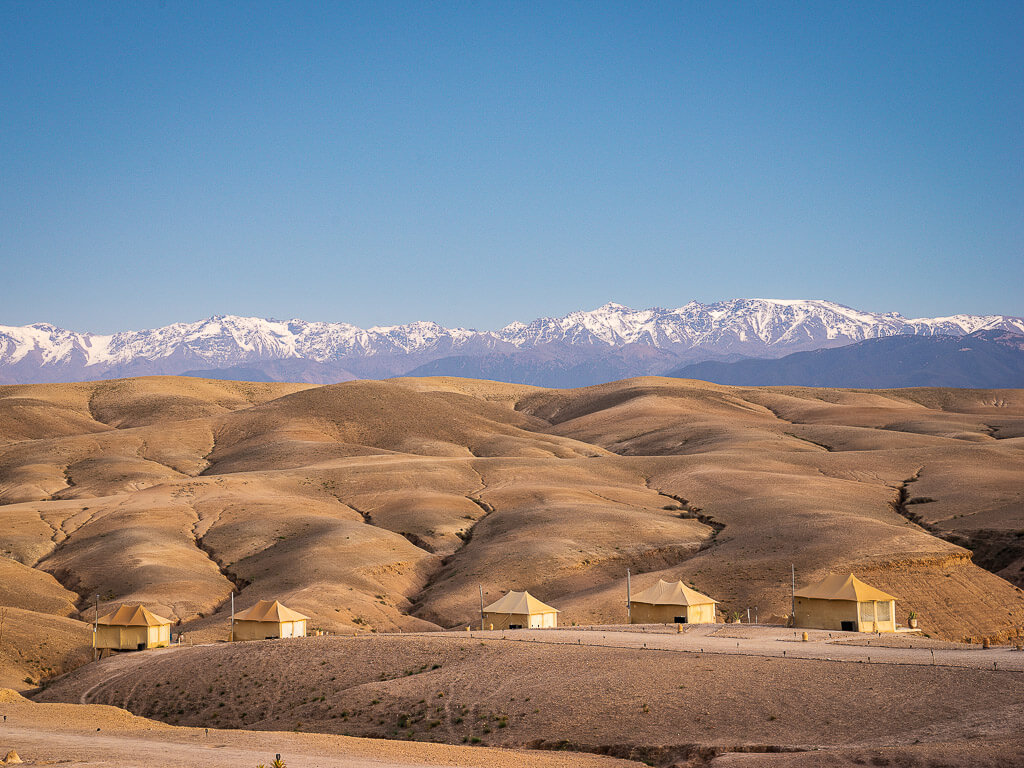
The Désert d’Agafay stone desert is located just under an hour outside Marrakesh in a south-westerly direction with a view of the High Atlas. Even if it doesn’t have the impressive sand dunes of the Ergs south of the Atlas, the wasteland with its view of the often snow-covered mountains is well worth a visit.
An overnight stay in one of the camps is a special experience, but a sunset dinner followed by a return to Marrakesh is also highly recommended.
Referral links: The links marked with an asterisk (*) are referral links, also known as affiliate links. This means that if you buy something via such a link, we receive a small commission. There is no additional cost to you, but with your purchase you help us to continue creating useful content for travelers. Enjoy our stories and “Shukran” for your support!
If you are spending more than 3 days in Marrakesh and have not planned a round trip to the sand deserts in the south of Morocco, you should definitely plan an day-trip here.
You can get a good overview of the offers in advance from GetYourGuide: Sunset in the Agafay Desert*.
If you are also visiting the sand desert on your trip, perhaps a balloon ride would be a nice addition to your stay in Marrakesh.
In our blog article about the best day trips from Marrakesh you can find even more information about activities in the area.
Marrakesh is also changing — and we are keeping this article up to date for you. Last revised in April 2026.
- Agafay Stone Desert Info
- Agafay Desert: Dinner at sunset
- Day trips
- Explore the Agafay Desert on your own
- Overnight stay under the starry sky of Agafay
- Directions to the camp
- Agafay desert camps: What to expect at camp
- Activities in the desert camps
- Photography in the Agafay Desert: light, motifs and the best time of day
- Food, drink and evening entertainment
- Return to the city
- Frequently asked questions about the Agafay Desert
Important to know:
Distance from Marrakesh approx. 30 km
45–60 minutes travel time
Costs for an excursion: 20–30€ (basic), 50€+ (luxury)
Best time to visit: Spring/Autumn
One of the most popular excursions from Marrakesh: Quad biking, camel rides, dinner under the stars in the stone desert
Agafay Stone Desert Info
The Agafay is not a desert in the classic sense, but geologically a so-called reg. This term is derived from the Arabic and describes a scree desert that consists neither of sand nor coarse pebbles, but is formed when the wind carries away the fine sand particles and leaves only the coarser scree behind. A well-known example of a reg is the Gobi Desert.
For nomadic Berber tribes, the Agafay was not an empty space, but grazing land: after the winter rains, when grass sprouts on the barren ground for a short time, they drove their herds of goats and sheep here.
The Agafay stretches over around 150,000 hectares at an altitude of 600 to 700 meters, high enough for the nights to be pleasantly cool even in summer and close enough to the Atlas for the peaks to dominate the horizon on a clear day. With an average of 120 millimetres of rainfall per year, it is one of the driest regions around Marrakesh — less than a quarter of what the city itself receives.
The first camp in Agafay was opened in 2003, and since 2010 tourism has really taken off and the former wasteland has been experiencing unbroken interest from visitors ever since.
From Marrakesh, there are many ways to explore the desert at the foot of the Atlas Mountains: Day trips, dinner spectacles or overnight stays in one of the desert camps.
Agafay Desert: Dinner at sunset
There’s an old saying that you’re spoiled for choice. So it is with the choice of dinner options in Marrakesh. In addition to historic restaurants in charming, time-honored courtyards with orange trees and palm trees, there are dreamy restaurants on the rooftop terraces high above the medina. Competing with them are the kitchens of the riads, where excellent menus are prepared in the traditional way. The new town, on the other hand, offers a wide range of stylish restaurants with cuisines from all over the world and in all price categories.
And yet it is worth looking beyond Marrakesh.
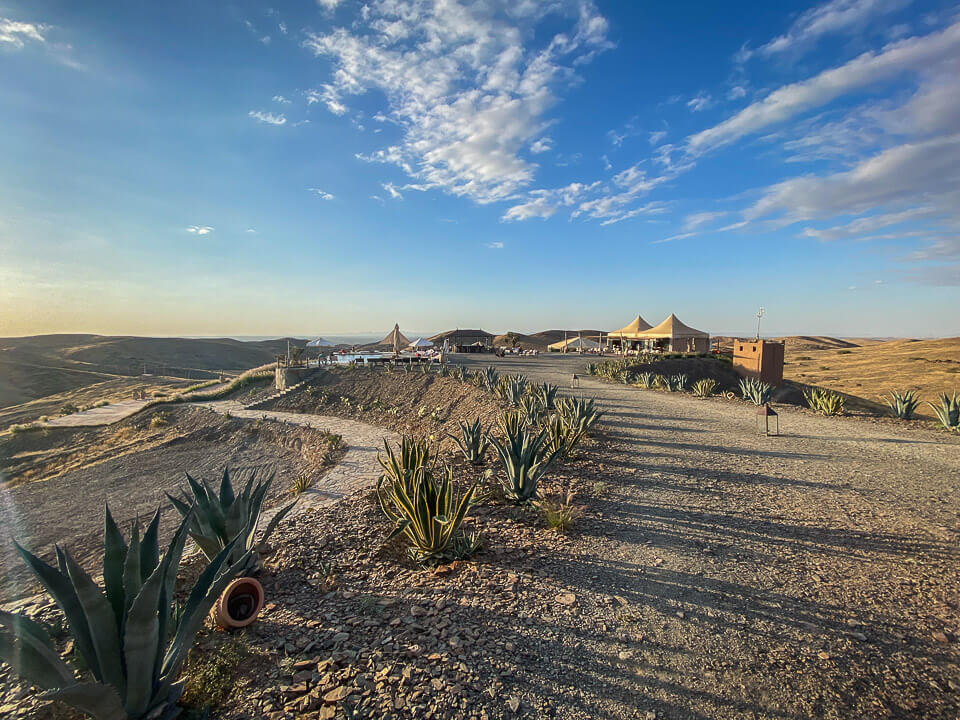
Just a few kilometers beyond the city limits, where people can no longer wrest olive and orange groves from the rocky ground, the stone desert of Agafay begins.
Agafay rises from the plain as a gentle hilltop, dominated by reddish-yellow rock and sand.
During the day, the heat shimmers over the stones and blurs the horizon.

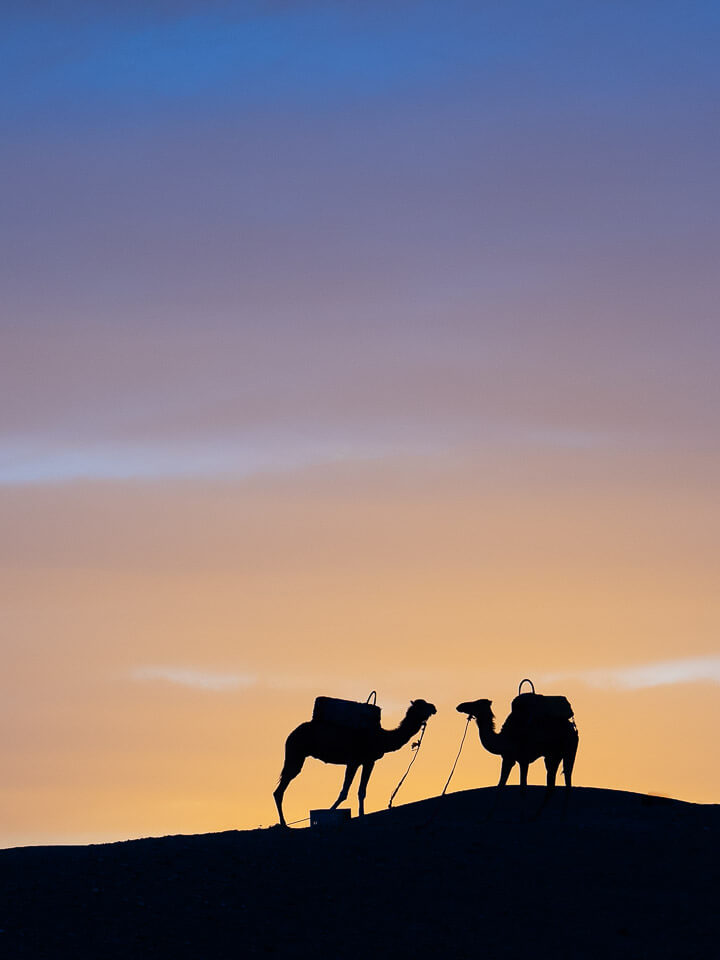
The sunset here is a very special spectacle in its own right. I love the soft orange and purple hues that stretch across the endless sky until the moment when the first star twinkles and the campfire is lit. It’s a great experience every time, different every time, because the sky dictates the script.
Want to share or save this post?
Day trips
An arrangement for a visit to Agafay is very easy to organize. As in most riads and accommodations, our staff at Riad Selouane will be happy to arrange a booking at the desired camp. For a dinner with activities such as camel rides, it is usually sufficient to book one or two days in advance.
In the city itself, there is an agency for all kinds of excursions in almost every alleyway. They can usually be recognized by colourful pictures of off-road vehicles, camel rides, quads or desert scenes. The excursions can always be booked including arrival and departure.
Some camps pick up guests in Marrakesh by bus and bring them back again. Here you should pay attention to the pick-up location and time.
Payment is usually made immediately, drinks are charged at the end of the camp and must be paid before departure.
A private transfer via your riad has the advantage that the drivers will contact the riad, combined with the service of being accompanied to the pick-up point.

In addition to cash, the camps also accept major credit cards — payment by app is not yet widely available.
The agencies in the city often offer inexpensive packages to the simple 2‑star camps, but the quality of the camps and the food cannot keep up with the luxury camps. However, these prices include everything except drinks and, depending on the offer, even the camel ride or quad biking.
A package for 20 — 30€ per person including food, transfer and pool doesn’t have to be bad, but you should take a close look at the reviews of the camp on a review site such as Tripadvisor beforehand. Unfortunately, conditions change quite quickly, so you should always obtain up-to-date information.
In the luxury 4‑star camps, the standard is much higher, the quality of the food better and the facilities more stylish. These camps can rarely be booked as a package. You book directly with the camp, plus a private transfer and any activities.

We particularly like the dinner at Inara Camp* and the camps La Pause and White Camel Lodge.
The prices are high, for a dinner you have to calculate over 50€ without drinks, but the atmosphere in these camps is something very special.
There are even private tents for hire for a romantic dinner* for two.
You can also visit all the camps during the day and have lunch there. After a camel ride or a quad bike ride, hanging out by the pool before heading back into town in the evening is also a great experience.
There are many offers for a Day Pass with pool and lunch*. The stylish Inara Camp also offers a day pass with lunch*.
For an afternoon in Agafay, you should definitely bring sun cream, sunglasses and headgear.
Another tip: many excursions combine the Agafay with a visit to an argan oil cooperative. However, argan trees do not grow in the region around Marrakesh — they are native to the southwest of Morocco, between Essaouira and the Anti-Atlas. The nuts that are processed in these cooperatives come from there. So if you want to see the traditional home of the argan tree, you are better off on the way to Essaouira than in the Agafay.
Explore the Agafay Desert on your own
The Agafay Desert can also be reached without a booked tour — if you want to travel independently, you will find everything you need for a successful excursion on your own.
The easiest way to get to the Agafay is by rental car or private driver. Agafay is located around 30 kilometers southwest of Marrakesh, the drive takes around 40 minutes depending on traffic. The route leads towards Agafay (R212) and turns off onto an unnamed road to the south shortly before the village of the same name — well signposted and easy to drive, even for inexperienced drivers.
We do not recommend taking a taxi, as there are no return options on site.
Without a booked camp or program, the Agafay is initially an open stone desert — impressive, but little developed. Most of the camps are private and only accessible to guests. If you are traveling on your own, you should be aware that it is hardly possible to visit one of the camps without booking in advance.
Some camps offer day tickets or the option of using the facilities for a minimum fee — a good compromise between independence and comfort. Nevertheless, we would advise you to clarify this by telephone beforehand.
Exploring the Agafay on your own can be particularly interesting for photographers. The desert has no special viewpoints or corners that you absolutely have to see, it is fairly uniform and it mainly depends on the clouds as to whether the desert is photographically interesting or not.
Along the main road, there are several opportunities to rent quads or ride a camel. There are no signposted hiking trails or other infrastructure that is not associated with a camp.
It is important to know that there are no supply options outside the camps. Sun protection, sufficient water and sturdy footwear are definitely advisable. Offline maps are also recommended.
For travellers who appreciate freedom and spontaneity, the Agafay on their own is definitely appealing — especially for a quiet morning or sunset away from organized groups. However, if you want to get the best out of the Agafay — campfire, dinner, Bedouin tent atmosphere — an organized tour or evening excursion is often better and less stressful.
Overnight stay under the starry sky of Agafay
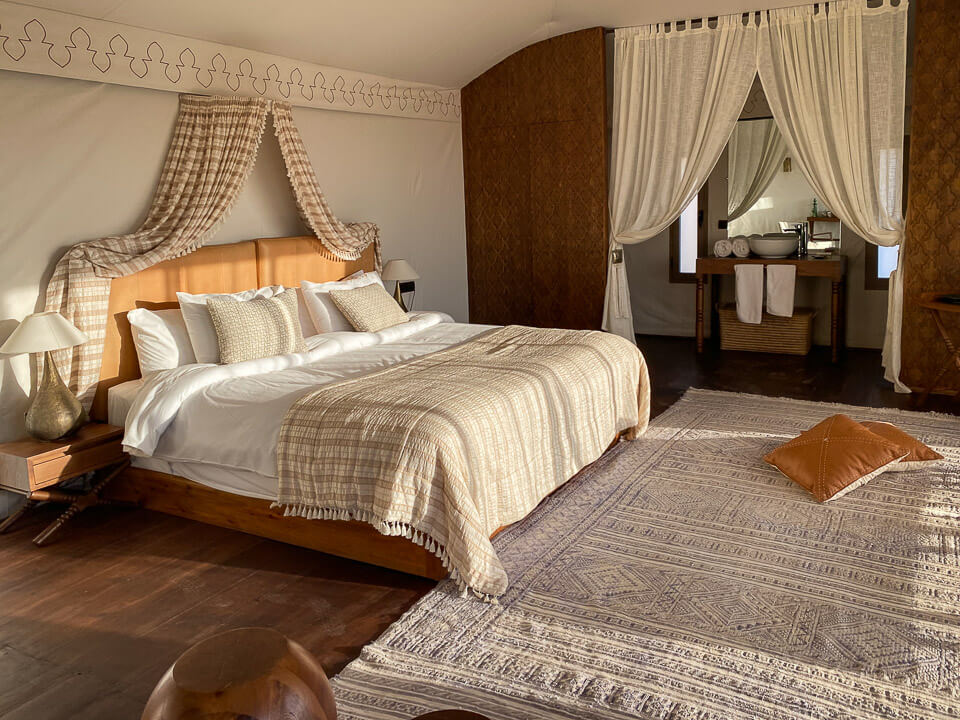
In addition to the restaurant camps, numerous desert camps have been established in recent years that also offer overnight accommodation — from simple Berber tent accommodation to comfortable glamping lodges with their own pool.
The range is wide: some camps focus on authenticity and simplicity, others on luxury with four-poster beds, terraces and candlelight dinners. Some accommodation options are attached to the day camps, while the most luxurious lodges are open exclusively for overnight guests.
What they all have in common is their remoteness, the sweeping view over the stony desert and — when the sky is clear — a starry sky that would be unthinkable in the city.
The program is almost the same as for the dinner camps: camel rides, quad biking, sunset, a traditional Moroccan dinner and campfire with or without a show.
But the morning belongs to silence: breakfast at sunrise, before the first day trippers arrive, with a view of the barren hills and the High Atlas. Those who get up early enough have the desert almost to themselves.
If you are thinking about spending the night in the Agafay Desert, you can book directly with the camps or via tour operators in Marrakesh, e.g. at the fantastic Camp Terrasses d’Agafay*.
Early booking is recommended, especially in the high season in October and March/April.
In our opinion, an overnight stay in the Agafay Desert is only worthwhile if you are not planning a round trip through the country. If you have already been to a sandy desert or the Sahara dunes are on your itinerary, an evening trip to the Agafay will suffice.
Even if you only have Marrakesh on the program and want to save yourself a hotel change, an overnight stay in the Agafay desert is not necessary, as the most beautiful part is the evening sunset — and you can also experience this on the half-day excursion.
Directions to the camp
An exact time and location will be specified for pick-up by the organizer. However, it is advisable to ensure a pick-up time no later than three hours before sunset in Marrakesh. This leaves plenty of time in the camp to see everything before the light of the sun begins to enchant the landscape.
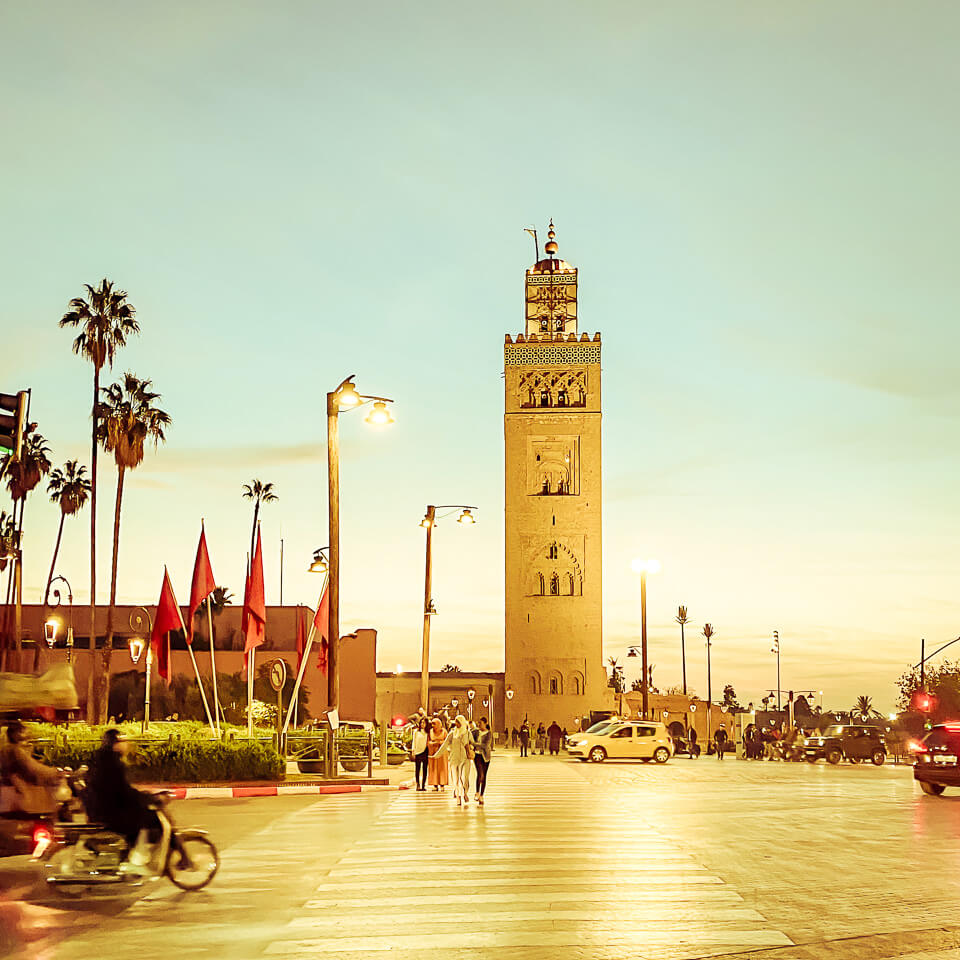
The tour operators usually have meeting points in the area around the Jemaa el Fna. The journey is made in comfortable and well-maintained off-road vehicles or minibuses. The journey takes around 40 minutes to an hour, depending on traffic.
You can conveniently book a private driver through your hotel.
If the conversations with the driver actually run out of steam, which is actually out of the question given the sheer endless base of stories and myths about Marrakesh, then sounds from the radio set the rhythm of the journey. If you don’t like Berber music, we recommend the Moroccan hit parade on Hit-Radio Marrakech. Often a copy of the hits known from their homeland — just in Arabic.

With music blaring from the radio, the many construction sites of the incredibly fast-growing city fly past to the left and right of the road. As bleak as the building sites look, large advertising signs announce what will soon be realized here as a new standard of living. And despite all this progress, donkey carts, rickety bicycles and smoking mopeds with up to four people on them are part of the everyday street scene. Just like the olive and orange groves and eucalyptus trees further out, outside the new building areas.
Would you like to receive news from us?
Our newsletter delivers the latest information from our blog directly to you by email!
You can unsubscribe at any time.
You can find out more in our privacy policy.
Agafay desert camps: What to expect at camp
Arranged like a silhouette, the view sweeps to the ever higher mountain ranges of the foothills, which are bordered by the peaks of the High Atlas rising to over 4,000 meters. Until well into early summer, these peaks with their snow-covered slopes reflect the light of the sun burning up on the western horizon in a special way.
To the north, the soft bare hilltops of other hills can be seen, while to the west the sun seems to sink into the foothills of the Agafay cliffs.

During the day, the stone desert itself appears empty and barren at first glance.
The narrow asphalt road winds like a snake between the rocky hilltops and leads seemingly to nowhere. Now and again, lonely signposts with bold names such as Scarabeo Camp, Canyon Lodge or Oxygen Camp Lodge appear out of this nothingness. If the eye follows the indicated direction and the dusty track, the view is once again lost in nothingness. From time to time, plumes of dust on the horizon show that this road is actually being used.
The appearance of desolation is deceptive, as camps with surprisingly luxurious facilities await visitors at the end of the dusty and seemingly endless slopes.

Tents are lined up along the hilltop with the best views of the surrounding countryside, offering everything from simple rooms to luxury rooms.
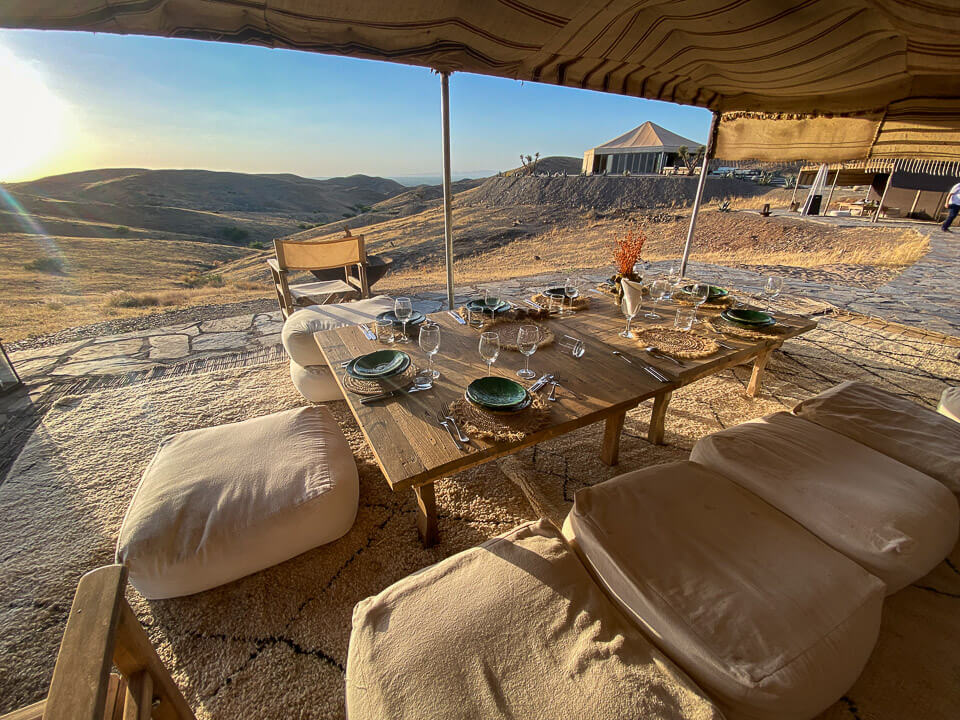
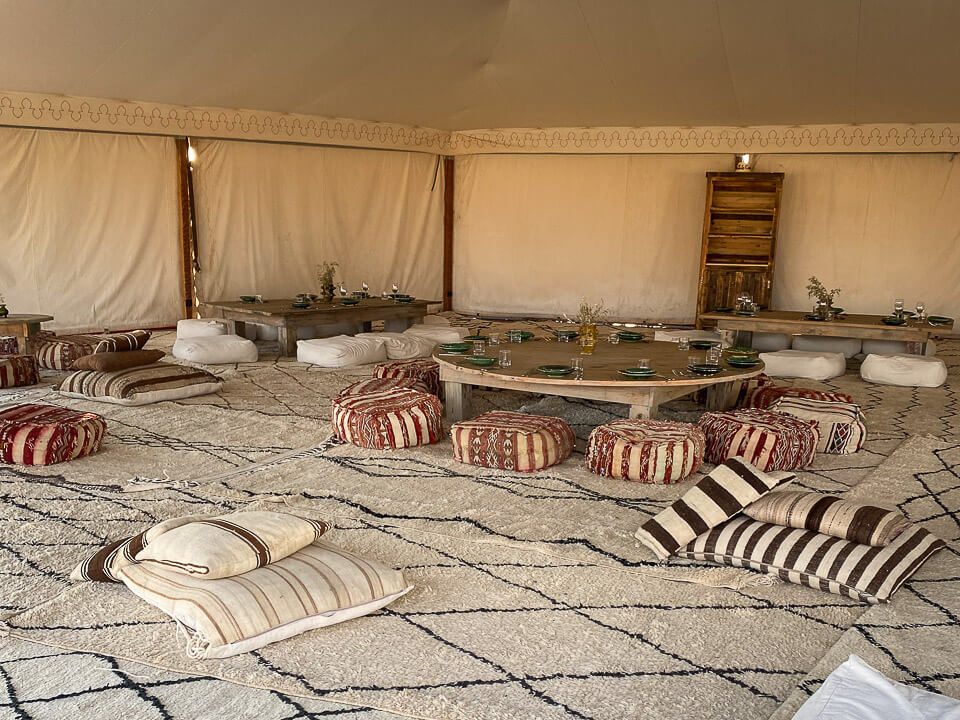
Behind the tents, the clear water of a pool sparkles in the sunlight on a plateau, next to a panorama bar. A little further away and with a feeling for the beautiful view, there is a beautifully furnished tent for the evening dinner.

I always find it a spectacular experience to sit by the pool and soak up the light, the wind and the magnificent scenery with a glass of wine.
Every second, the sun changes the colors in the sky and the surrounding mountains from sun-bright to purple-red to the pale blue of the first foothills of the night.
The heat of the day gives way to the pleasant coolness of the night.
After the spectacular display of colors, you can enjoy a multi-course dinner with original Moroccan dishes.
As darkness falls, torches and fires are lit. The darker it gets, the more the camp transforms into a magical African place, where shadows dance across the tent walls and strange sounds whirl in the air. As dark companions, the mountains constantly watch over the horizon, while a breathtaking starry sky stretches from left to right above our heads.
The silhouettes of the mountains disappear in the dark, but the lights of the Berber villages appear on the mountain flanks.
The evening ends sitting by one of the fires, the air carrying the sounds of drums and bells from a little further away. With a drink in your hand, friends and good company engrossed in conversation, spanned by a sea of a thousand twinkling stars — this is the final magic of the Agafay, a combination of experience and Moroccan magic.
An unforgettable memory.
Activities in the desert camps
Many camps offer other activities in addition to dinner.
In addition to private dinners for two in your own tent, larger tents can be booked for groups through to event tents for entire parties and all occasions.
As a rule, day guests are also allowed to use the pool in the camps. It is therefore advisable to pack a towel and swimwear. Towels are only provided as a service in a few camps. Additional charges may apply for use of the pool.

Quad bike rides* through the Agafay with a view of the town of Marrakesh resting on the plain are at the top of the list of daytime activities, preferably in combination with lunch by the pool* or a dinner show*. Buggy rides are also offered.
Each camp also offers the option of short or extended camel rides*. The camels themselves are extremely patient and gentle animals for the inexperienced rider.

Led by a guide, they walk over sand and stony ground with their soft, large hooves and great surefootedness.
From the slightly swaying saddle, you get yet another view of the landscape.
Imagine traveling to Timbuktu in this way for 56 days…
In addition to the typical activities, there are also far more unusual offers:
What would it be like to play paintball in the desert? Or with the paraglider over the desert?*
Unforgettable pictures are created during a photo shoot with a flying dress in the Agafay*.
For the romantics, there is even the option of a Moroccan wedding ceremony* with henna decorations and traditional clothing. Not officially valid, of course, but still a beautiful idea to celebrate love.
For travelers who want to explore the Agafay on their own during the day, there are also guided quad tours that start at Lalla Takerkoust Lake and lead through the desert to the camp zone — a different perspective on the landscape that opens up the route from north to south.
In the evening, the camps offer a variety of spectacles from music and shows with riders and horses to fireworks.
However, as a musician with rattles and drums gives at least one interlude at every dinner and the evening itself conveys so many impressions, you can enjoy Moroccan culture in almost every camp.
The Agafay has a pronounced desert climate: as warm as it may be during the day, it can get very cold in the evening, especially in the winter months. I’ve sat around the campfire shivering all too often: a warm jacket against the night-time chill makes me feel more comfortable after dinner as I gaze at the endless sea of stars.
Looking for a hotel in Marrakesh?
Top location in the medina, breakfast included, an oasis of peace in the middle of the souks:
The Riad Selouane is the ideal address for your city trip!

Photography in the Agafay Desert: light, motifs and the best time of day
Ochre and grey dominate the color palette, the landscape is barren and vast. The Agafay impresses with its reduction, the light models the gentle hilltops and draws long shadows.
Great, graphic-looking shots are possible here in the evening. The High Atlas is illuminated by the setting sun and makes for great landscape photos. The warm light is also ideal for atmospheric portraits.

In flat midday light, on the other hand, the landscape appears devoid of contrast — the best reason for photographers to choose an evening excursion over a day trip.
The Agafay is particularly beautiful in winter and early spring. From November, the first snow can fall in the High Atlas, and the contrast between the ochre-colored stone desert in the foreground and the bright white peaks behind it is unparalleled.
Incidentally, not all camps offer the same view. The White Camel Lodge, for example, has a beautiful sunset, as it offers a wide view to the west, but has no unobstructed view of the High Atlas, as its peaks are hidden behind the hills. Inara Camp, on the other hand, has a great view of the mountains as it is located quite far back in the Agafay. It is therefore worth researching in advance which camp you would like to visit.
The sky is a decisive factor for good pictures. A cloudless sky does not necessarily guarantee a beautiful sunset!
In January and February, the sunsets are often glowing red and the air is clear, the snow-covered mountains hovering unrealistically over the desert. Unfortunately, this is also the time of year when there is the greatest risk of catching one of the few bad days.
At other times of the year, a bright blue sky during the day can fade to a dull hue in the evening, or clouds can cover the mountains in the evening.
A scattered cloud cover, on the other hand, can create a dramatic atmosphere: when individual clouds break the light, the desert is illuminated in several different ways within minutes, resulting in colorful sunsets.

After dark, an incredible starry sky awaits visitors. The light pollution in Agafay is quite low, so there are good opportunities for astrophotography.
The fire show at the camp also offers great photo opportunities.
If you are traveling to Agafay specifically to take photos, you should take a look at the weather forecast before booking. In Marrakesh, there are often days that are very hazy — the Sahara sends sand over the mountains from time to time — and so all photo dreams in the Agafay are invalid.
Food, drink and evening entertainment
A peppermint tea is usually served as a welcome to the camp.
In addition to local drinks and fresh juices, many camps also offer Moroccan wines and a selection of spirits. Well-known brands are represented among the soft drinks, for example tonic water. Beer usually comes from a can.
It usually starts with a soup, often a delicious harira.
Then there is a selection of tagine, with lamb or chicken, refined with fruits such as dates and plums. It is served with couscous.

The meals in the camps are divided into three or four courses, traditionally Moroccan, and are served in tents or on seated terraces in front of the tents, depending on your preference and the time of year.
Finally, there is of course a dessert, here the options are very varied and depend on the cooking skills of the respective kitchen.
The food is usually accompanied by pleasant background music from an often very rustic music system. The music is interspersed with a live performance between courses. Three or more musicians come from table to table with drums and bells and, in addition to the rhythm and singing, make the pom-poms on their caps spin. It looks easier than it is, I fail every time — but you are welcome to try it out for yourself.
As a typical conclusion to the meal, a mint tea is offered again at the end of the meal with some dry cookies that are customary in the country.
A small tip should be given to both the service in the camp and the driver if they were friendly and attentive.
Return to the city
The drivers wait patiently at the entrance to the camp in their off-road vehicles or buses and are often overwhelmed by European punctuality. The motto is: always take your time and enjoy the evening.
The return journey through the darkness makes the route seem completely different. Lights in the desert indicate where there are more camps or where other off-road vehicles are on their way back to Marrakesh.
From time to time, people walk along the road in the dark — their destination seems completely unknown to the observer — there is only wasteland here! When you reach the R212, eucalyptus trees line the road again and suddenly there is life on the road, even late at night. In the light of neon lamps, barbecue stands whiz past the window. Thick clouds of smoke rise from the hot barbecue fires into the darkness. Children run through the night, dogs watch the cars and cyclists perform some daredevil maneuvers.
For the drivers of the camps, this is an everyday occurrence; they know the game as well as most of the passers-by. Every now and then people say hello or sound the horn.
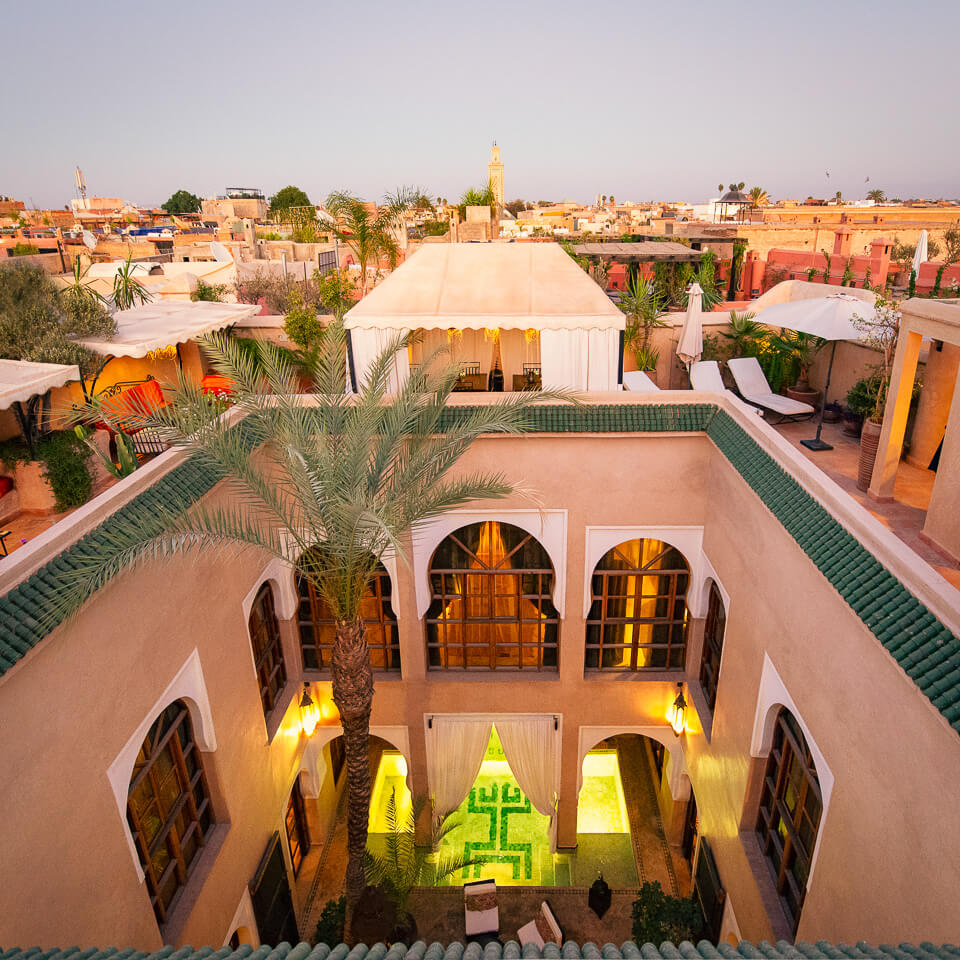
Many riads in the city are located directly in the medina, like the Riad Selouane. As most of the alleyways are too narrow for cars, off-road vehicles or minibuses do not drive right up to the riad. So you still have to walk a little to get to the hotel.
The streets and alleyways of the medina are safe at night, with young men in particular occasionally approaching the tourists. Here it is important to decline politely but firmly.
More caution is needed for orientation! As the traders have dismantled all their stalls and cleared away the lavish displays of goods, every alleyway looks completely different at night than it does during the day.
Many riads therefore consider it part of their service to pick up their guests personally after an evening out and accompany them directly to the riad.

An evening in the Agafay Desert is a very special experience!
Frequently asked questions about the Agafay Desert
Here you will find answers to the most frequently asked questions from our guests.
-
How far is the Agafay Desert from Marrakesh?
The Agafay Desert is located around 30 kilometers southwest of Marrakesh. The drive takes around 40 to 60 minutes, depending on traffic. The road is in good condition, but there are often gravel tracks to the camps themselves.
-
Is it possible to stay overnight in the Agafay Desert?
Yes, several camps offer tents and lodges for overnight stays. However, if you want to experience an evening in the desert from Marrakesh without spending the night, a half-day excursion with dinner is well advised.
-
When is the best time to visit the Agafay Desert?
The most pleasant months are spring (March to May) and fall (September to November). Temperatures are mild during the day and the nights are pleasantly cool. In summer, it can be over 40°C during the day; in winter, the nights can be very cold — a warm jacket is a must.
-
How much does a trip to the Agafay Desert cost?
Prices vary depending on the offer and camp. Simple packages with transfers, dinner and activities start from around €20–30 per person. In the upscale 4‑star camps, you can expect to pay over €50 per person for dinner alone — but the atmosphere and quality is significantly higher.
-
What activities are there in the Agafay Desert?
Most camps offer camel rides, quad bike rides, use of the pool and a traditional Moroccan dinner with live music. There are also more unusual offers such as paragliding over the desert, paintball or a romantic dinner in a private tent.
-
How do I organize an excursion to the Agafay Desert?
The easiest option is to book through your own hotel or riad — the manager will organize the reservation at the desired camp as well as the transfer. Alternatively, travel agencies in the city offer packages that bundle transfers, dinner and activities. Booking one or two days in advance is usually sufficient.
-
Can you explore the Agafay Desert on your own?
Yes, with a rental car or private driver it is easy to get there. However, there is hardly any infrastructure or supply options outside the camps. Most camps are only accessible to registered guests — it is therefore advisable to contact them in advance. Sufficient water, sun protection and sturdy shoes are essential.
-
What should you pack for an evening at Agafay?
Even if the day was warm, the Agafay Desert cools down considerably in the evening, especially in the winter months. A warm jacket is recommended. Also: sun cream and sunglasses for the day, a towel and swimwear for the pool and cash or credit card for drinks and tips.
Looking for more information about Marrakesh?
Visit our travel guide to learn more about the sights of Marrakesh and Morocco!

About the author:
Svenja Keller is an architect from the Black Forest and has lost her heart to Marrakesh — to the souks, the handicrafts, the colors and a city where beauty is not a concept, but everyday life. She has been running the Riad Selouane in the medina since 2019. What she writes about Marrakesh does not come from a travel guide, but from years as a hostess, observer and passionate connoisseur of this city.