


After a long drive along winding roads, the first view of the fortified village of Aït Ben Haddou seems like a dream from 1001 nights to me as an architect: Tower houses made of red clay, stacked on top of each other, growing up the barren hill from the lush palm grove by the river and blending in with the surroundings in terms of color.
Aït Ben Haddou (also known as Ait Ben Haddou without the double i‑dot) is the best-preserved adobe settlement in Morocco and has been a UNESCO World Heritage Site since 1987. A visit to the most beautiful village in Morocco, which is now one of the most visited sights in the country, is definitely a worthwhile stop on your round trip.

International visitors’ interest in Aït Ben Haddou has been aroused by numerous film productions. The best known are certainly Game of Thrones and Gladiator.
We give you an overview of the history and architecture of Aït Ben Haddou and tell you what you need to know for a visit.
Morocco is also changing — and we are keeping this article up to date for you. Last revised in April 2026.

Meet the author:
Svenja Keller is a german architect from the Black Forest and has been running the Riad Selouane in the medina of Marrakesh since 2019.
- Aït Ben Haddou at a glance
- How do you get to Aït Ben Haddou?
- The best time to travel
- The visit of Aït Ben Haddou
- What to see and do in Aït Ben Haddou?
- The most beautiful photo spots
- Aït Ben Haddou as a movie set
- Is Aït Ben Haddou worth a day trip from Marrakesh?
- The history of Aït Ben Haddou
- Why Aït Ben Haddou is a Unesco World Heritage Site
- Towering buildings made of clay characterize the architecture
- How does building with clay work?
- Frequently asked questions about Aït Ben Haddou
Want to share or save this post?
Aït Ben Haddou at a glance
Aït Ben Haddou is located at an altitude of around 1,300 meters on the southern edge of the High Atlas — far enough away from Marrakesh to plan the journey there carefully. The long driving times are no coincidence: the route leads over the Tizi n’Tichka Pass, one of the highest mountain passes in Morocco, with tight bends and impressive views. Those who know this will arrive more relaxed.
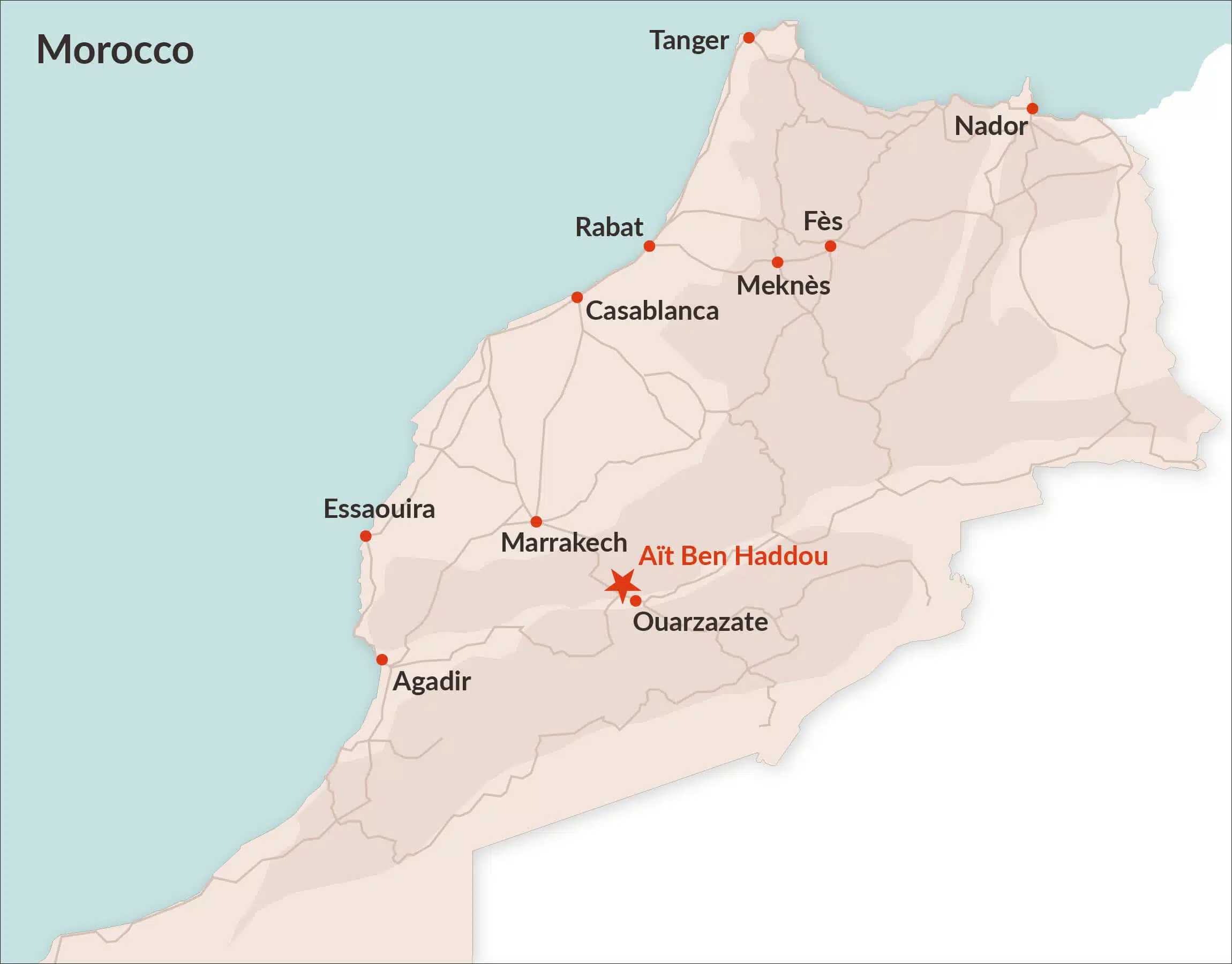
Ouarzazate is about 30 kilometers to the south.
Important to know:
Admission is free of charge!
2 — 3 hours are sufficient!
The best time to travel is in spring and fall!
It takes almost 4 hours to cover the 180 km from Marrakesh!
How do you get to Aït Ben Haddou?
Aït Ben Haddou is located in the province of Ouarzazate on the southern edge of the High Atlas and is easy to explore on a day trip from Marrakesh or as a stop on a round trip.
Referral links: The links marked with an asterisk (*) are referral links, also known as affiliate links. This means that if you buy something via such a link, we receive a small commission. There is no additional cost to you, but with your purchase you help us to continue creating useful content for travelers. Enjoy our stories and “Shukran” for your support!
A day trip from Marrakesh* is feasible and is also offered by many agencies, but it means sitting in the car for over 7 hours — leaving little time for exploring. The day trippers therefore start very early and don’t get back until late. If you are looking for an alternative excursion, you are sure to find what you are looking for in our blog article on the most popular day trips from Marrakesh.
The classic day trip program includes a drive over the High Atlas with a stop in Aït Ben Haddou, followed by a visit to the film studios in Ouarzazate and then the long drive back. After all, it is over 180 kilometers from Marrakesh to Aït Ben Haddou.
It is more relaxed to plan the impressive village as a stop on a road trip through Morocco’s south.
Both a day trip and the multi-day trips can be booked as a group tour or as an individual trip with a private driver.
Of course, you can also visit the town in your own rental car.

A large, free parking lot is located in the new part of the village on the riverbed, from there it is only a few minutes’ walk to the entrance of the Ksar.
It is also possible to travel by bus from Marrakesh to Ouarzazate, but then you will need a taxi for the last 30 kilometers.
The itinerary for a visit as part of a multi-day round trip to the desert* is similar to a day trip: start in Marrakesh in the morning and drive over the High Atlas with a photo stop at the Tizi n’Tichka Pass, then arrive in Aït Ben Haddou after a winding 4‑hour drive.
After a visit to the village and a break in one of the restaurants, the tour continues to Ouarzazate, usually for a visit to the film studios and an overnight stay.
That’s enough for a first impression, even if the village has more to offer than a short stop would suggest. However, the morning hours between the red clay walls are particularly atmospheric and worth seeing. It is therefore perhaps worth considering spending the night in Aït Ben Haddou.
The sunrise from one of the roof terraces of the surrounding hotels is also magnificent. The sunset is rather unspectacular, but the soft light in the evening is ideal for taking photos in the village itself.
A visit to the village is particularly nice in the morning and late afternoon, when the day tourists have gone and it is quieter.
It is also nice to drive from Marrakesh via the Telouet Valley with the large Glaoui Kasbah and then via the Ounila Valley.
The narrow green ribbon along the river, the crammed houses in the small villages and the magnificent landscape have a very original feel. Two-day tours with an overnight stay in Aït Ben Haddou* are offered from Marrakesh, which leave enough time to discover the villages and kasbahs in the surrounding area.
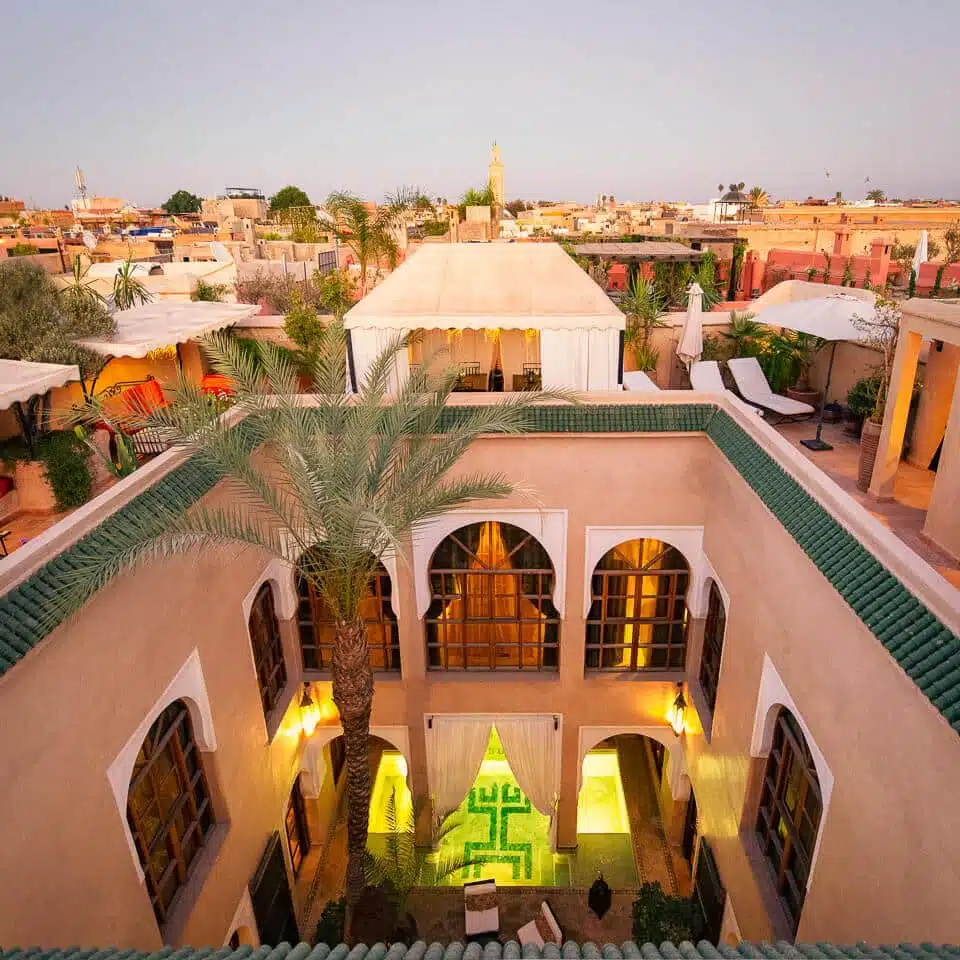
Looking for a hotel in Marrakesh?
Top location in the medina, breakfast included, an oasis of peace in the middle of the souks:
The Riad Selouane is the ideal address for your city trip!
The best time to travel
The best time to visit Aït Ben Haddou is spring (March to May) and fall (September to November). Temperatures are then between 20 and 30 degrees, the light is soft and warm — ideal for photography and exploring.
It can get very hot in the region in summer, often over 40 degrees. However, if you are traveling in summer, you should make the most of the early morning or late afternoon — in the midday heat, the landscape appears flat and lacking in contrast, and the ascent through the village becomes a strain.
Winter has its own special charm: the days are mild and sunny, but the nights are very cold — Aït Ben Haddou lies at an altitude of 1,300 meters, and you can feel it. When the Assif Mellah carries water in winter or early spring, the landscape is particularly atmospheric: the narrow green ribbon along the river, the red clay towers behind it — a picture that you don’t get to see in the summer months.
Before visiting in winter, you should check the current road conditions: The Tizi n’Tichka Pass may be closed during snowfall or only accessible with snow chains. After heavy rainfall, the route through the Ounila Valley may also be impassable.
Regardless of the time of year, the most beautiful hours in the village are early morning and late afternoon, when the light is low and the day trippers are not yet — or no longer — there.
At lunchtime in particular, it is sometimes very crowded as all the day trippers flood the village. A visit after 3 p.m. helps here, as it is then much quieter.
The visit of Aït Ben Haddou
To get to the old village center, walk down to the river in the new settlement. If there is water in the river, take the bridge, otherwise you can simply cross the dry riverbed. Cross the bridge to reach the main entrance to the village, further down by the river there is a side entrance.
Entry to the Ksar is free of charge. Within the village there are several houses and small museums that can be visited for a small entrance fee — including a house on Berber oral tradition and a house on film history. These are run by local cooperatives and are well worth a visit.
You can explore the small village on your own or hire a local guide for a few euros at the entrance to the village.
A few of the old adobe houses are still inhabited and the locals are happy to show you their homes for a small fee. In some houses you can climb up to the roof terrace and enjoy the view.

In the alleyways there are a few souvenir stores and a few rustic cafés with roof terraces from which you have a beautiful view of the bustling houses.
The village is located on a steep slope, up which narrow steps lead. If you want to enjoy the fantastic view of the village, the river oasis and the High Atlas from the top, a strenuous climb is required. Sturdy shoes, a bottle of water and a sun hat are advisable. Depending on the time of year, the sun beats down mercilessly.
Once at the top, you have a fantastic panoramic view of the river valley, the snow-capped mountains and the surrounding desert landscape. The view is most beautiful in the morning and towards evening, when the light is soft. In the midday heat, the view is often dull and lacking in contrast.
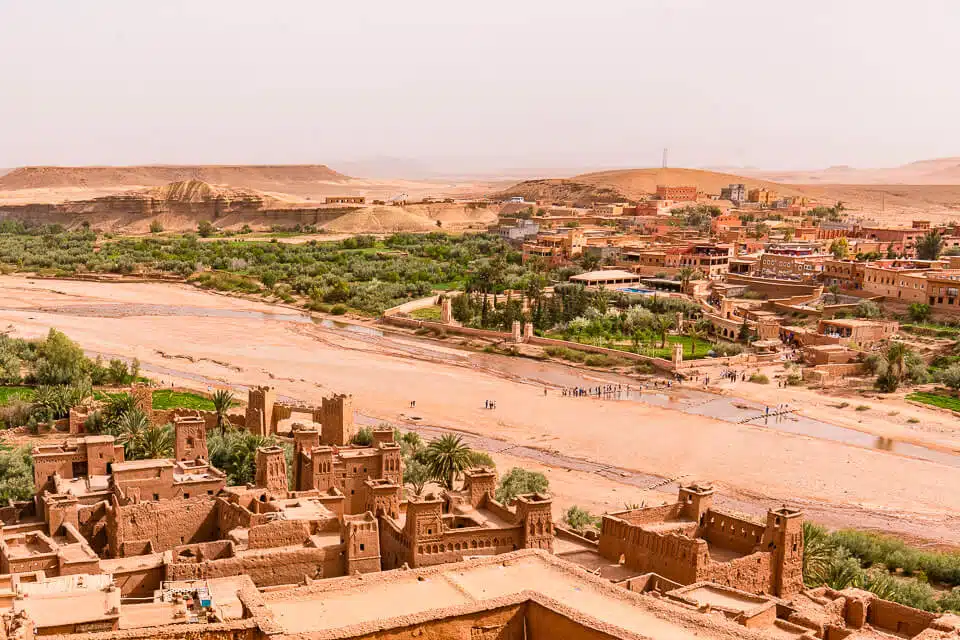
On the way back, you can take the rear exit from the village and walk along the river. From down here you can take great photos of the towering residential towers.
The best view of Aït Ben Haddou itself is from the new settlement. There are numerous restaurants, cafés and hotels here from whose roof terraces you can enjoy the view.
What to see and do in Aït Ben Haddou?
The charm of Aït Ben Haddou lies in the intricate clay architecture that stretches picturesquely up the mountain. The view from the other side of the river, in particular, is sure to make for a photo opportunity and is best enjoyed with a mint tea on one of the restaurant terraces.
The town itself is divided into a modern and an old half by the river. The old part is of course interesting for tourists, but almost all the restaurants and hotels are in the new part.
The river Assif Mellah (sometimes also called Assif Ounila) flows between the two parts of the village, but it does not carry water all year round.
When the water flows in winter and spring, the village looks particularly beautiful, as the contrast between the water and the barren surroundings is impressive.
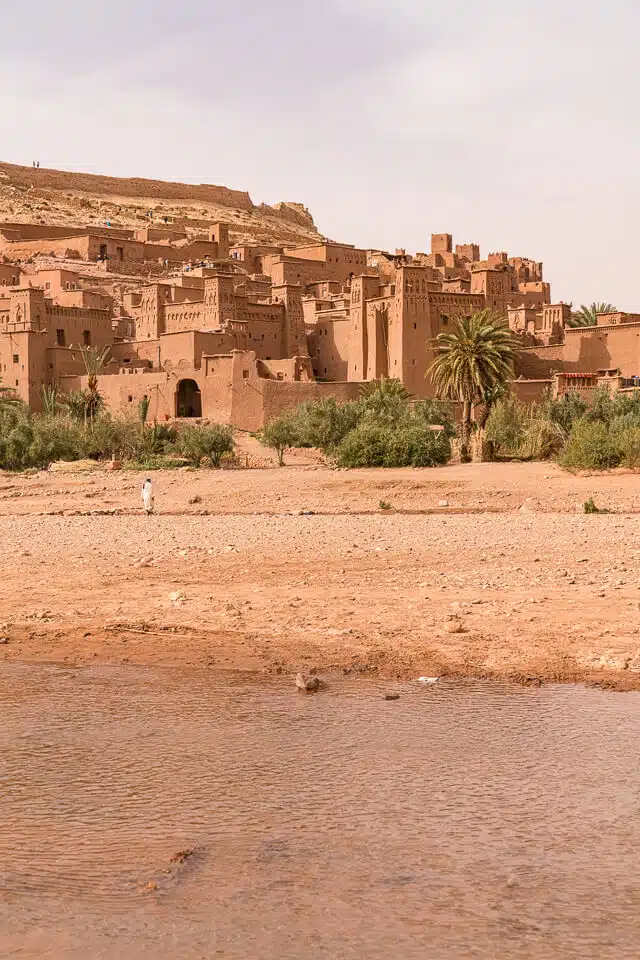
Aït Ben Haddou lies at an altitude of around 1300 meters. It can therefore get very cold at night, especially in winter. Ouarzazate, one of the most important cities in the south of Morocco, is approx. 30 km away.
In the surrounding area, you can experience the river oasis and the barren landscape around it on horseback.
You want to visit Aït Ben Haddou?
At GetYourGuide* you will find various day and multi-day tours to the south of Morocco

The most beautiful photo spots
Aït Ben Haddou is a photographically rewarding place — but the time of day makes a considerable difference.
The classic view of the village opens up from the new part of the village, from the roof terraces of the restaurants and cafés on the riverbank. Here you have the overall view with the soaring clay towers against the barren mountain landscape.
The lighting for this perspective is at its best in the afternoon — the light falls from the right side and models the façades.
In the morning there is often backlighting here, towards evening the shadows become very strong, and at midday the houses appear flat and lacking in contrast due to the lack of shadows.

When the Assif Mellah has water — in winter and early spring — the view from the riverbed on the opposite side is particularly worthwhile: the water in the foreground, the palm trees and the red clay towers behind it make for one of the most beautiful perspectives that Aït Ben Haddou has to offer.
Below the village, along the riverbed, some date palms grow in the gardens — from here you can take beautiful pictures even when the riverbed is dry, combining the green of the oasis with the red clay towers in the background.
Inside the village, it is worth taking detailed photos: the geometric patterns on the towers, the weathered clay façades, the wooden doors. If you climb onto one of the roof terraces of the small cafés in the old village, you can photograph the towers up close — a perspective that is not available from below.
An overcast sky — more common than you might think in the south of the High Atlas — is very attractive for detailed shots in the village: the soft, diffuse light highlights the structures of the clay façades particularly finely. For the large panorama, however, you need a clear day.
Aït Ben Haddou as a movie set
Morocco has close ties to the Hollywood film industry. Ouarzazate is home to the major Atlas Film Studios, which are internationally renowned and where numerous blockbusters have been filmed. Marrakesh hosts the annual film festival in November, which even attracts Hollywood celebrities such as Brad Pitt.
The impressive setting of the village has served as the backdrop for more than 20 films. The best known are certainly Lawrence of Arabia (1962), Gladiator (2000) and Game of Thrones (season 3, 2013).
Other films shot here include The Mummy (1999), Alexander (2004), Prince of Persia (2010) and Ben Hur (2016).
In front of the old village center is an imposing gate with two watchtowers facing the river. This deceptively real gate was built for the Game of Thrones series and has been a major point of contention ever since, as tourists love the gates, but Unesco is of the opinion that they have no place in a World Heritage Site.
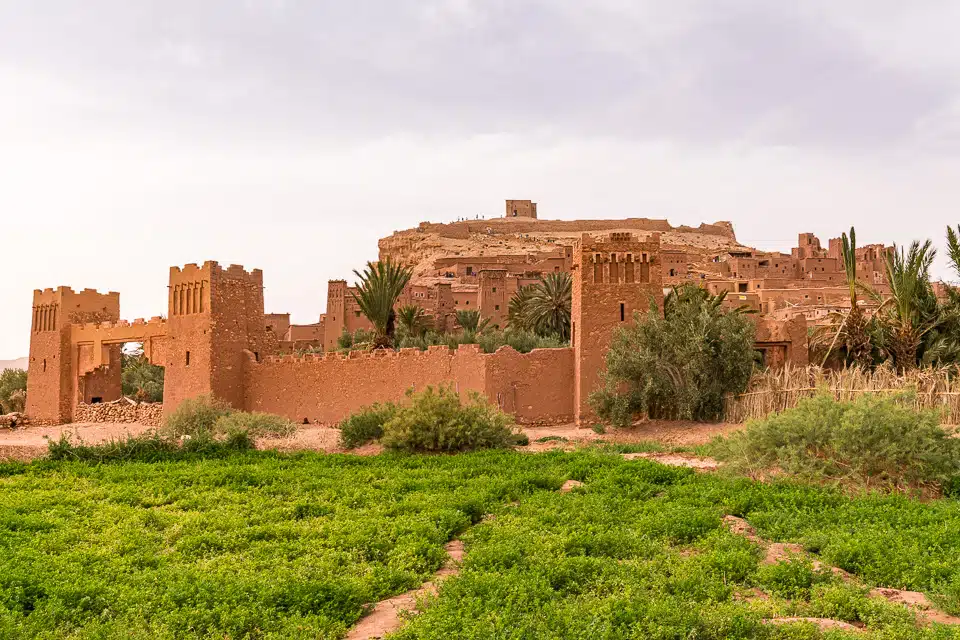
A detailed report on the filming locations for Game of Thrones in Morocco can be found at Escape from Reality.
The numerous film productions have certainly also contributed to the preservation of the settlement. As early as 1970, buildings and walls were repaired for a film shoot.
An arena for gladiator fights was built outside the village especially for the film Gladiator. There is nothing left of it today, but you can find photos of the film set in some stores.
Is Aït Ben Haddou worth a day trip from Marrakesh?
It depends on the expectation — but in my opinion, not really.
The route over the High Atlas is scenically impressive, but with over 180 kilometers and a winding pass road, it is also long and exhausting. You’re in the car for a good seven hours there and back — so there’s little time to really take in the place. Day trips are often offered because Aït Ben Haddou provides spectacular images, but that alone hardly justifies the effort.
If you really want to experience Aït Ben Haddou, it is better to plan it as a stop on a round trip through southern Morocco — combined with the Draa Valley, the Dades Gorges or the desert. Then the place unfolds its full effect and the trip across the Atlas becomes an experience rather than a compulsory exercise.
If you are looking for a worthwhile day trip from Marrakesh, you will find beautiful alternatives in the surrounding area — such as the Ourika Valley in the High Atlas.
The history of Aït Ben Haddou
The first written records date back to the 17th century, but the oral tradition of the settlement’s history goes back to the 11th century.
The village was named after the first governor of the place, Amghar Ben-Haddou, who ruled here in the 11th century. Aït means clan, so the Berbers of the Ben Haddou tribe live here.
Aït Ben Haddou used to be a trading post along the caravan route that connected Marrakesh with Timbuktu and Sudan. Gold, salt and ivory were transported from Equatorial Africa on the long journey and sold on in Marrakesh all the way to Europe.
In the Draa and Dades valleys, there are many fortified villages with similar architecture, but nowhere are the houses as spectacularly situated on the mountainside as here.
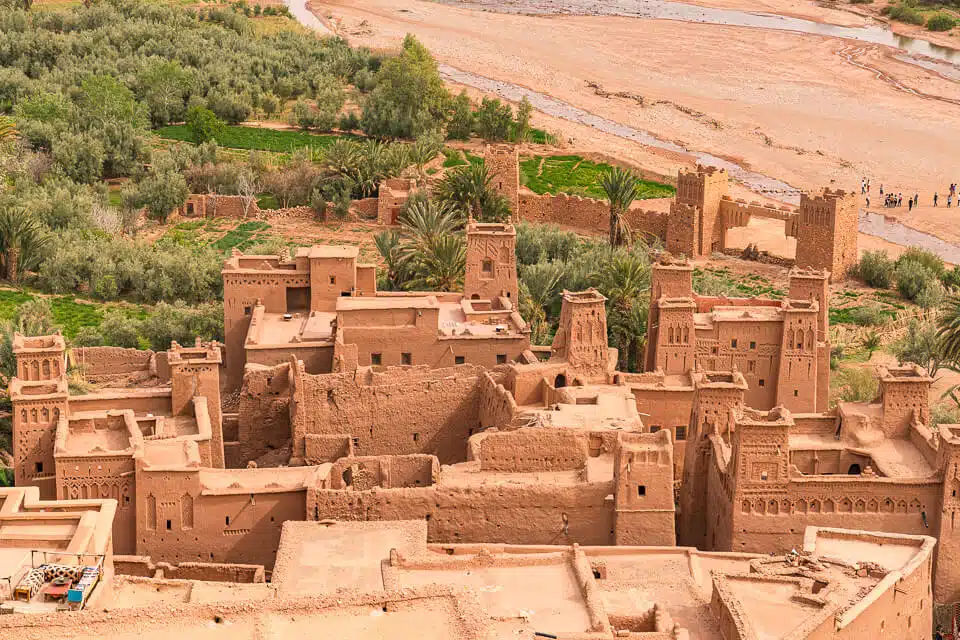
Until well into the 20th century, the inhabitants lived as self-sufficient farmers, supplemented by a small amount of livestock, mainly sheep and goats. In the village’s heyday, more than 1000 people are said to have lived within the fortified walls.
Since the 1960s, a settlement with modern amenities such as electricity and running water has been built on the other side of the river, and the inhabitants have abandoned the old clay buildings.
The road through the Ounila Valley was only paved in 2012, before that it was a dusty track.
Today, only a few families still live in the village’s traditional clay buildings and are happy to show off their homes to paying visitors. The village is now more of an open-air museum than a functioning village community.
What’s more, its status as a UNESCO World Heritage Site does not allow it to be repaired with modern materials such as concrete or steel. In this respect, tourism is a blessing, as visitors come to see the old village, which is therefore worth preserving.
Nobody can blame the residents for no longer wanting to live in the old buildings, but it would be a shame if the village were to fall into disrepair. The many visitors are therefore welcome, even if it can get very crowded at times. A visit is definitely worthwhile and every visit contributes to the preservation of this beautiful ensemble.
Why Aït Ben Haddou is a Unesco World Heritage Site
The picturesque village has been a UNESCO World Heritage Site since 1987 and has benefited from this distinction ever since. But what are the reasons for its inclusion?
Aït Ben Haddou is a traditional fortified village, a so-called Ksar (plural: Ksour) of the pre-sahara.
There are still many ksour in the High Atlas, some are over 1000 years old, many are dilapidated and uninhabited, some have been renovated and now house beautiful guesthouses. Aït Ben Haddou is so unique in its preserved old substance that it has been a Unesco World Heritage Site since 1987.

However, it was not only the architectural ensemble that was decisive for the World Heritage status. The collaborative organization of the building trade is also remarkable.
In Berber culture, knowledge of architecture and other traditions has been passed down in families for centuries.
As with many village communities, the construction of larger structures used to only be possible together.
A special feature of the Berber villages is that most of the villages are owned by the community and managed by the village councils. The maintenance and new construction of buildings is decided jointly and strengthens social cohesion.
The communal buildings include a mosque, a village square, a threshing floor, a karavanserai, two cemeteries (Muslim and Jewish) and the shrine of Saint Sidi Ali. These buildings belong to the village community and are also built, maintained and repaired collectively.
Today, hardly anyone still lives in the old ksar, which makes maintenance much more difficult. Like everywhere else, young people are moving to the big cities and so there are fewer and fewer knowledgeable residents left to look after the buildings.
The Moroccan government has launched a program to preserve the unique site, providing assistance with repairs to the building structure and raising awareness of traditional building culture among the population.
Aït Ben Haddou is now regarded as a flagship for the sensitive treatment of old buildings, the needs of the population and marketing as a tourist destination.
Would you like to receive news from us?
Our newsletter delivers the latest information from our blog directly to you by email!
You can unsubscribe at any time.
You can find out more in our privacy policy.
Towering buildings made of clay characterize the architecture
Aït Ben Haddou is a typical clay settlement of the pre-Sahara. It is fortified and surrounded by high walls flanked by strong corner towers. This architectural style is widespread from Libya to Mauritania and is referred to as a pre-Saharan settlement type.
Although the construction method is the same as it was thousands of years ago, the oldest buildings only date back to the 17th century due to the constant renovations.
I think these clay kasbahs in the south of Morocco are really great, all made from one building material, homogeneous and yet no two corners are the same, the many little towers are playful and elegant at the same time. It inspires the architect in me every time!
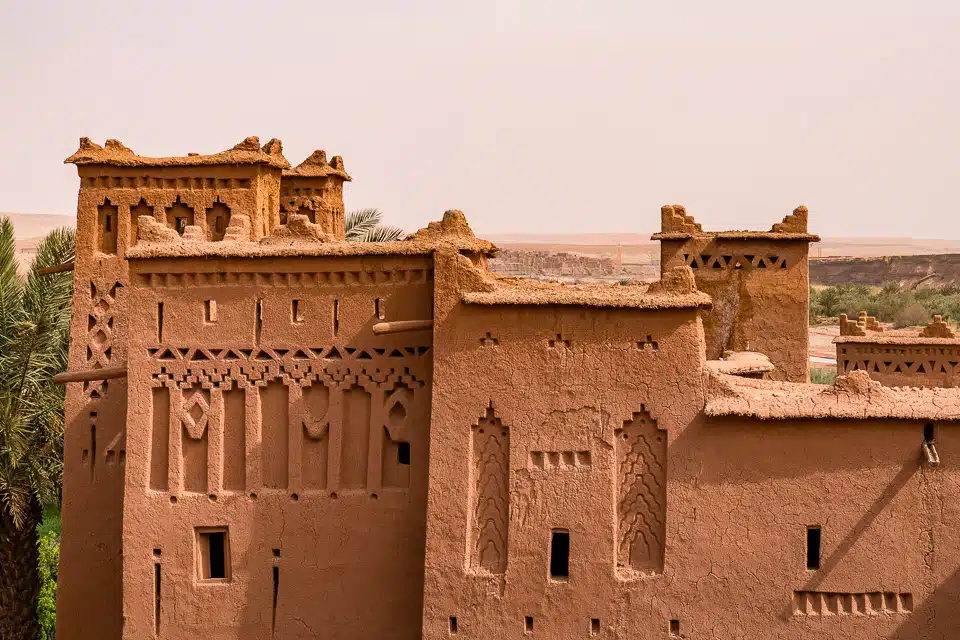
In the village itself, there are houses, sometimes real residential towers( calledtighremt ), and buildings that serve the common good. The narrow alleyways keep the summer heat at bay, as they are in the shade for much of the day, and in ancient times they were easier to defend than wide streets.
You can see from the elaborate decorations on the houses that functionality was not the only thing that was important to the villagers.
The upper part of the residential towers are decorated with geometric patterns which, according to ancient tradition, are supposed to ward off evil.
The buildings have only a few windows, but occasionally have ventilation slits to use the chimney effect to cool the living spaces in summer.
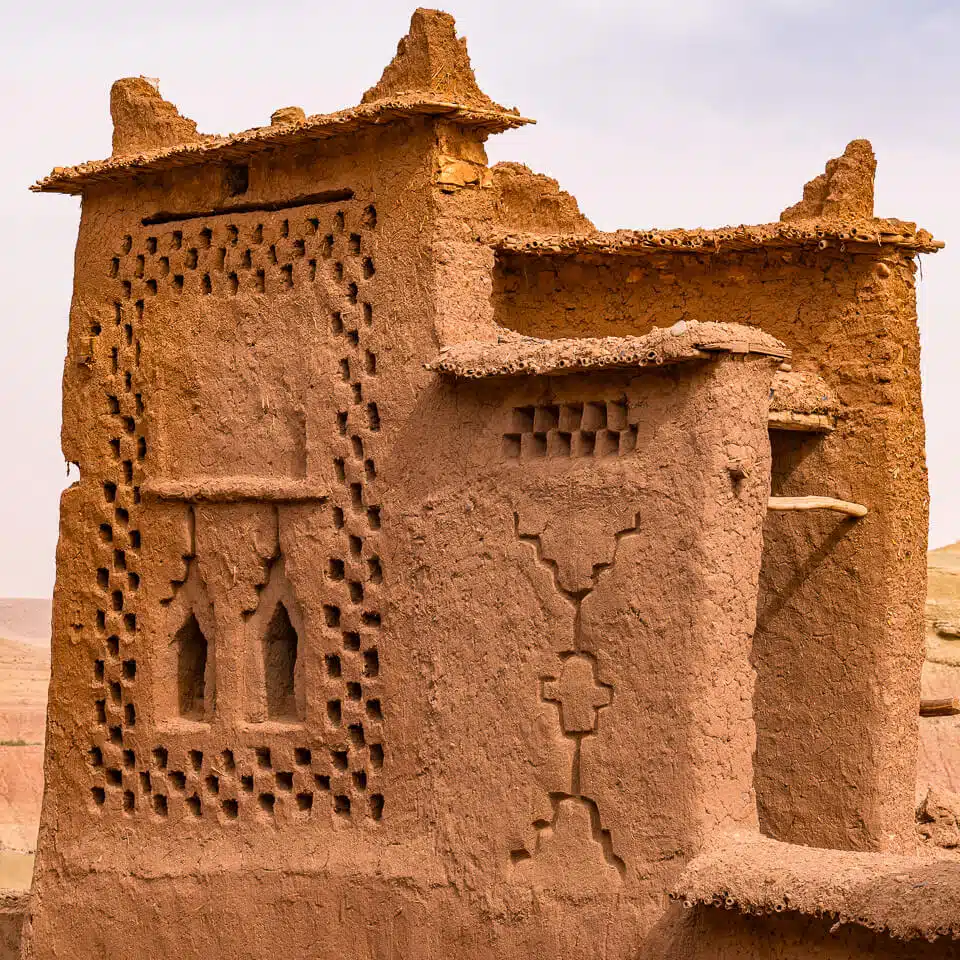
The rooms are traditionally laid out around inner courtyards and house stables and storage rooms on the first floor and living quarters on the upper floors.
On the hill above the village is the collective granary, which is unfortunately only a ruin today.
The grouping of buildings around the central granary is typical of this region and was intended to protect the villagers’ most valuable asset in the event of attacks.
There is no minaret to be found in the old village. Until the 20th century, mosque minarets were only common in large cities. Villages generally had prayer rooms without minarets.
The devastating earthquake in September 2023 damaged several buildings in the old village center. The granary on the hill above the village, which had already collapsed in places, was destroyed even more. Fortunately, the entire complex survived the earthquake without major damage.
Incidentally, as already mentioned, the fortified village itself is called a ksar. A kasbah, on the other hand, is a castle built from clay and can be located inside or outside a village. The kasbah offered the ruling Berber prince protection and living space, which is why the term kasbah is not appropriate for Aït Ben Haddou as a whole.
How does building with clay work?
As there are no forests in this region, people have learned to make use of the building materials available: Clay and palm wood.
These materials can be found in abundance around the village and the clay from the nearby river gives the walls their characteristic red tone.
Thanks to the natural building materials, the village blends harmoniously into its surroundings. At first glance, you could easily overlook the houses as they blend in with the color of the surroundings.
Clay as a building material for walls
The village’s buildings are constructed from molded, sun-dried clay bricks — a technique known as adobe, which differs from the rammed earth technique(pisé) used in the famous red city walls of Marrakesh, for example.
The houses are plastered with clay on both the outside and inside, which gives them their homogeneous appearance. Some houses have a plinth made of fieldstones, which is partially visible.
Clay is plentiful, cheap and can be worked without machines. The houses, which are built from dried clay bricks, keep cool in summer and warm in winter.
The craftsmen who specialize in building with clay are called maâlems and the techniques they use are over a thousand years old.
The clay is mixed with straw to increase its strength, spread in molds and dried in the sun.
The bricks are then walled up with — precisely — clay as mortar.
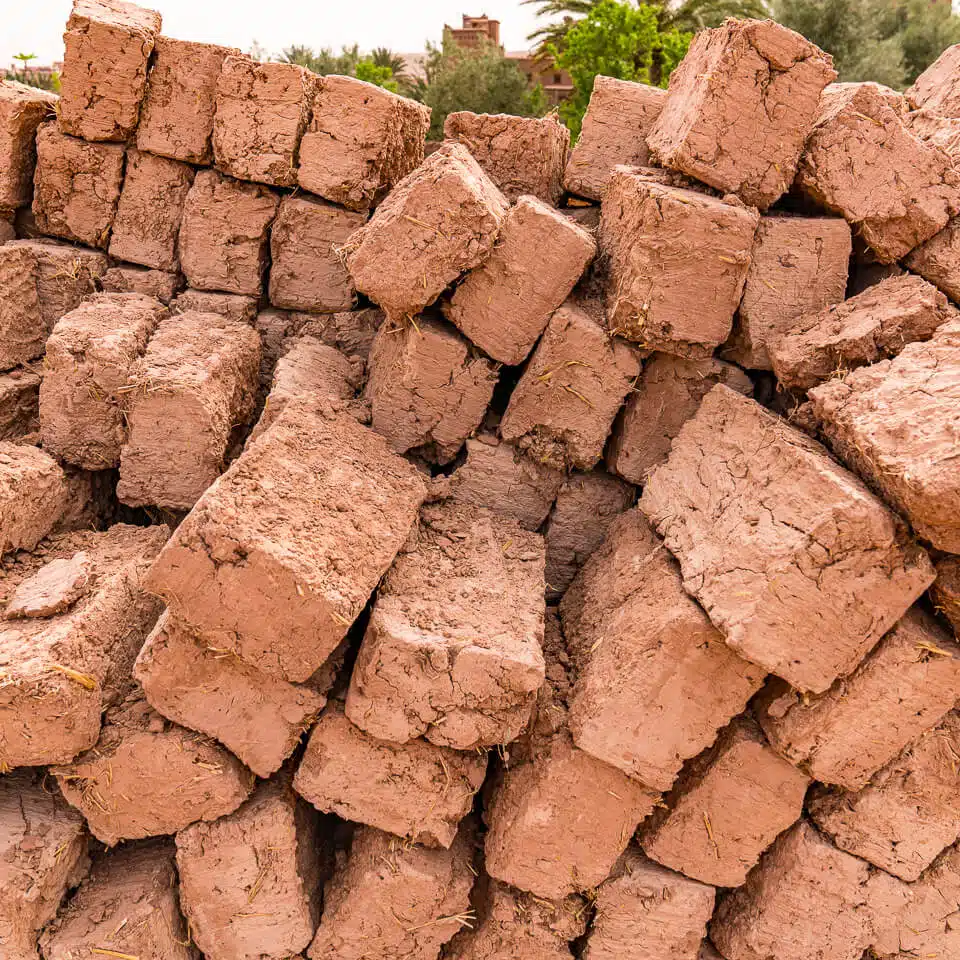
Because the building material is not very stable, thick walls are needed to support the tall buildings. The buildings lean against each other and support each other and it is not uncommon for the houses to be literally nested inside each other.
Palm wood and reed stalks provide the material for ceilings and roofs
The date palms that grow along the river bear little fruit due to the altitude, but are used as building material.
The trunks are used to make ceiling beams and the fibers are used to make mats and ropes. The palm fronds are used to make baskets and other utensils.
Reeds are also processed into mats and used as building material for ceilings and roofs.


For ceilings, palm wood beams are laid first, covered with reed mats and then sealed with a mixture of clay and straw
Doors and windows are made of wood. Glass was traditionally not used, and sometimes ornate metal gridswere placed in the window openings.

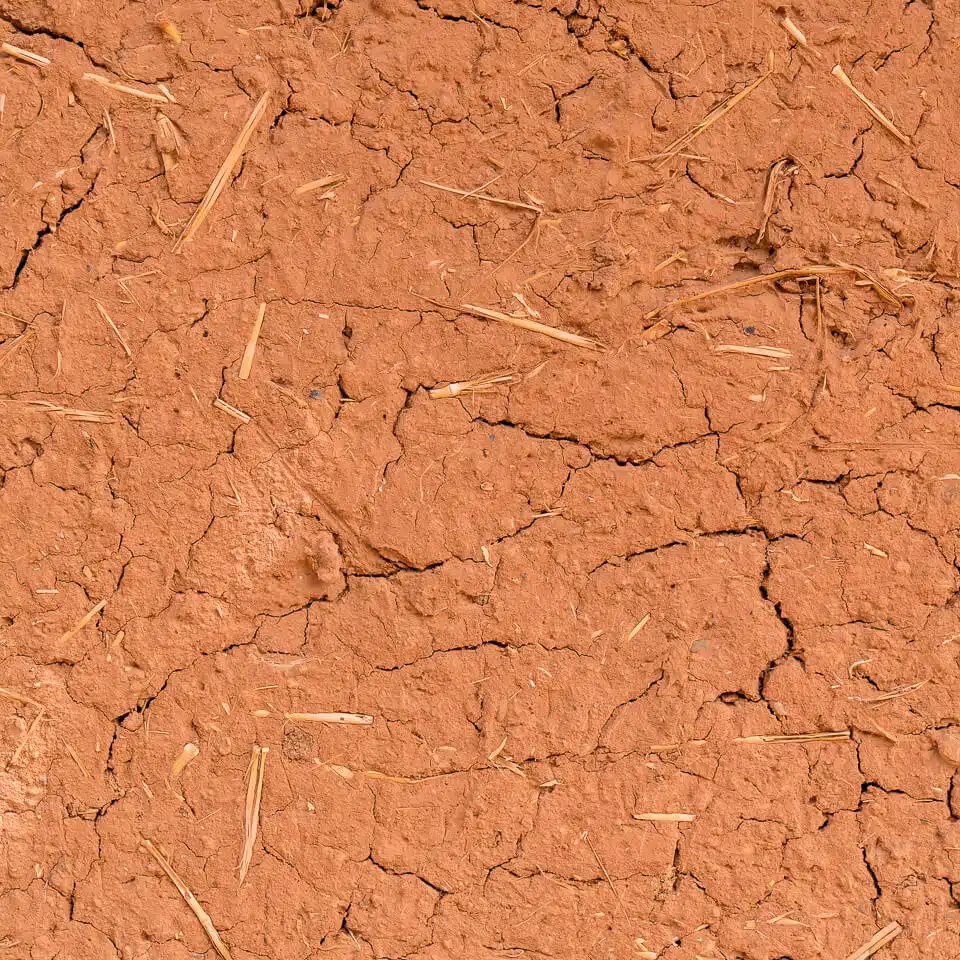
This economical and sustainable construction method also poses a problem with regard to the not very frequent, but often torrential rainfall: as the bricks are not burnt, there is a risk that the buildings will simply dissolve with every downpour. The scorching summer heat also affects the old walls, which virtually crumble under the Moroccan sun.
Even today, the settlement is extensively restored every three years, as the sun and occasional rain cause the walls to crumble. This construction method requires constant repair work, which is traditionally carried out by the village community, but is difficult nowadays as hardly anyone still lives in the old village.
This also creates a difficult paradox for Aït Ben Haddou: the masses of visitors cause the fragile structures to suffer, but the village needs enough paying visitors to maintain them and the interest of the tourists ensures that the maintenance of the buildings is worthwhile.

The clay architecture of Aït Ben Haddou is simply impressive!
Frequently asked questions about Aït Ben Haddou
Here you will find answers to the most frequently asked questions from our guests.
-
Does the entrance to Aït Ben Haddou cost anything?
Entry to the village is free. Within the village there are several houses and small museums that can be visited for a small entrance fee of 20–50 dirhams — including a house on the oral tradition of the Berbers and a house on the film history of the village.
-
How long should I plan for a visit?
Two to three hours are sufficient for a tour of the village. Those traveling from Marrakesh should plan a whole day — the drive over the High Atlas alone takes three and a half to four hours, depending on the route.
-
When is the best time to visit Aït Ben Haddou?
We recommend spring (March to May) and fall (September to November) with temperatures between 20 and 30 degrees. In summer, it can get over 40 degrees; if you are traveling then, you should take advantage of the early morning or late afternoon. In winter, the days are mild but the nights are very cold — and when the river is full of water, the landscape is particularly atmospheric.
-
How do you get to Aït Ben Haddou without a guided tour?
Aït Ben Haddou is easily accessible by rental car — the route over the Tizi n’Tichka Pass is a scenic experience anyway. Alternatively, there are long-distance buses from Marrakesh to Ouarzazate, from there it is about 30 kilometers by taxi.
-
Is it worth staying overnight on site?
Yes — the early morning hours and the evening, when the day trippers have left, are some of the most beautiful moments in the village. If you stay overnight, you can experience the sunrise from one of the roof terraces and take in the village in peace and quiet. It is worth looking carefully when choosing a hotel: There is some accommodation in the old village itself — the appeal of sleeping in the middle of it is great, but you don’t have a view of the ksar from outside. Hotels on the opposite side of the riverbed with a roof terrace overlooking the village are more recommendable — in the morning and evening, when the light is right, this perspective is simply unbeatable.
-
For which films and series has Aït Ben Haddou served as a backdrop?
The Ksar has been the filming location for more than 20 productions, including Lawrence of Arabia, Gladiator, Game of Thrones, The Mummy, Prince of Persia, Asterix & Obelix: Mission Cleopatra, Alexander and Ben Hur.
-
What is the difference between a ksar and a kasbah?
A ksar is a fortified village settlement with houses, storehouses and communal buildings, surrounded by a protective wall. A kasbah, on the other hand, is a manorial residential castle — the seat of a Berber prince or tribal leader. Aït Ben Haddou is a ksar, not a kasbah, even if the term is often used imprecisely in everyday life.
-
Is Aït Ben Haddou worth a day trip from Marrakesh?
Only to a limited extent. The drive over the High Atlas is long and strenuous with over 180 kilometers of winding pass road — you spend a good seven hours in the car there and back. Aït Ben Haddou works much better as a stop on a round trip through southern Morocco.
Looking for more information about Marrakesh?
Visit our travel guide to learn more about the sights of Marrakesh and Morocco!

About the author:
Svenja Keller is an architect from the Black Forest and has lost her heart to Marrakesh — to the souks, the handicrafts, the colors and a city where beauty is not a concept, but everyday life. She has been running the Riad Selouane in the medina since 2019. What she writes about Marrakesh does not come from a travel guide, but from years as a hostess, observer and passionate connoisseur of this city.